


Last updated: September 2026
Quick Answer: Fiber reinforced plastic (FRP) is a composite material made by embedding high-strength fibers — typically glass, carbon, or basalt — in a polymer resin matrix. The fibers carry the structural loads while the resin binds them and protects against the environment, producing a material that is stronger than steel by weight, corrosion-proof, and electrically non-conductive.
Fiber reinforced plastic (FRP) is a composite material consisting of a polymer resin matrix reinforced with fibers. The combination produces a material whose mechanical properties exceed what either constituent achieves alone: the fibers carry tensile and compressive loads that the resin matrix alone cannot sustain, while the resin binds the fibers, transfers loads between them, and protects them from environmental degradation. The result is a material class that offers high strength-to-weight ratio, corrosion resistance, and design flexibility across a range of fiber and resin combinations, each suited to different performance and cost requirements. For a fuller introduction to definitions, fiber and resin options, and typical uses, see our guide to what FRP is and how it works.
Composition: Fibers and Resin Systems
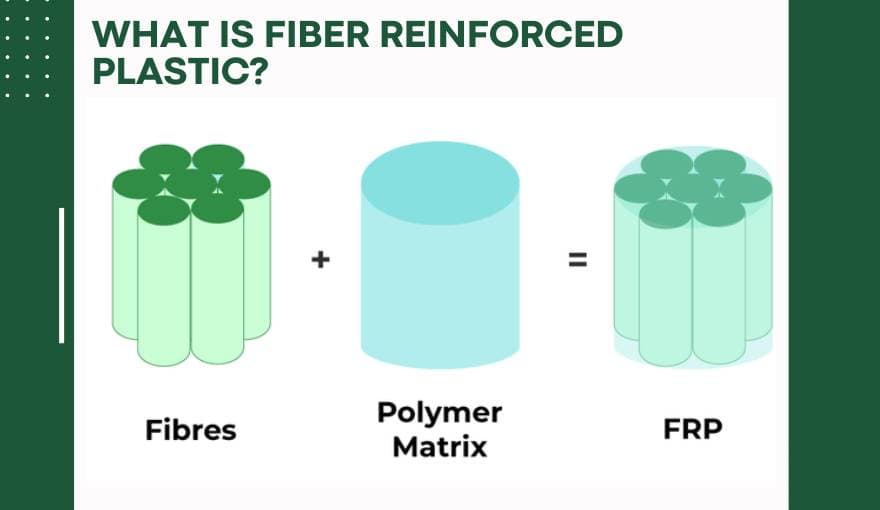
The mechanical properties of any FRP composite are determined primarily by fiber type, fiber volume fraction, fiber orientation, and resin system. These four variables can be adjusted independently to engineer a material for a specific load case and environment.
Fiber Types
E-glass fiber is the most widely used reinforcement in FRP by volume. It offers a tensile strength of approximately 3,450 MPa and elastic modulus of 72 GPa at moderate cost, making it the standard choice for construction, marine, automotive, and industrial FRP applications. ECR-glass (corrosion-resistant grade) provides improved resistance to acidic environments at modestly higher cost.
S-glass fiber has higher tensile strength (approximately 4,580 MPa) and modulus (86 GPa) than E-glass, used where higher specific strength is required — aerospace secondary structure, ballistic protection, high-performance sporting goods — at roughly 3–5 times the cost of E-glass.
Carbon fiber offers the highest stiffness-to-weight ratio of commonly used reinforcement fibers. Standard modulus grades (T300, T700) have tensile strength of 3,500–4,900 MPa and elastic modulus of 230–250 GPa. High-modulus grades reach 400–600 GPa. Carbon fiber is electrically conductive, which distinguishes it from glass and aramid fibers and affects both its applications and its handling requirements.
Aramid fiber (sold commercially as Kevlar, Twaron, and others) has tensile strength of approximately 3,600 MPa and modulus of 70–125 GPa depending on grade, with exceptional toughness and impact energy absorption. Its primary limitation is poor compressive strength relative to tensile strength and UV sensitivity that requires surface protection in exposed applications.
Basalt fiber is produced from volcanic basalt rock and offers properties between E-glass and S-glass — tensile strength approximately 4,840 MPa, modulus 89 GPa — with good chemical and thermal resistance. Its adoption is growing in infrastructure and marine applications as an alternative to E-glass at moderate cost premium.
Resin Systems
The polymer matrix binds the fibers, transfers load between them, and determines the composite’s resistance to chemicals, temperature, moisture, and UV radiation.
Unsaturated polyester is the most commonly used thermosetting resin in FRP, offering low cost, room-temperature cure capability, and adequate mechanical and chemical properties for most structural applications. Heat deflection temperature for standard grades is typically 70–120°C. It is widely used in marine, construction, and automotive FRP.
Vinyl ester provides better chemical resistance and toughness than standard polyester, with improved resistance to hydrolysis in wet and acidic environments. It is specified for FRP in chemical processing equipment, marine structural applications, and corrosive industrial environments where polyester’s chemical resistance is insufficient.
Epoxy offers the highest mechanical properties and adhesion of the common thermoset resins, along with low shrinkage during cure that improves dimensional accuracy. It is used in aerospace, high-performance automotive, and structural strengthening applications where the cost premium over polyester and vinyl ester is justified by performance requirements.
Polyurethane resin systems have gained adoption in pultrusion manufacturing for structural profiles where high toughness and impact resistance are required, as polyurethane laminates maintain better post-impact integrity than brittle polyester or vinyl ester systems.
Types of FRP by Fiber Reinforcement
FRP is broadly classified by the fiber type used as reinforcement, each category carrying different property profiles and cost positions:
Glass Fiber Reinforced Plastic (GFRP or GRP) is the largest category by volume, encompassing the majority of construction, marine, industrial, and consumer FRP applications. The term GRP is more common in European and Asian markets; GFRP and FRP are used interchangeably in North America for glass-based composites.
Carbon Fiber Reinforced Polymer (CFRP) is used where maximum stiffness-to-weight ratio is required and cost is secondary — aerospace primary structure, performance automotive, high-end sporting goods, and industrial applications where carbon’s electrical conductivity is needed or its non-magnetic properties are advantageous.
Aramid Fiber Reinforced Polymer (AFRP) is selected for applications requiring impact and ballistic resistance — protective equipment, blast-resistant panels, and bridge pier protection wrap — where aramid’s toughness and energy absorption outweigh its compressive strength limitations.
Basalt Fiber Reinforced Polymer (BFRP) is an emerging category used in rebar, geotechnical, and marine applications, particularly where the alkaline resistance of basalt fiber over E-glass in concrete environments is a specification requirement.
Manufacturing Processes

FRP is produced by a range of processes, each suited to different part geometries, production volumes, and performance requirements.
Pultrusion is a continuous manufacturing process where fiber rovings and mats are pulled through a resin bath and then through a heated die that shapes and cures the profile. It produces constant cross-section structural profiles — rods, bars, tubes, angles, channels, I-beams — at high production rates of 0.5–2 m/min with consistent fiber volume fraction (55–65%) and excellent dimensional repeatability. Pultrusion is the most cost-effective process for long structural profiles in volume production and is the primary manufacturing method for FRP structural shapes used in construction, infrastructure, and industrial applications.
Hand lay-up is the simplest FRP manufacturing method: fiber reinforcement is manually placed in a mold and resin is applied by brush or roller. It is flexible and requires minimal tooling investment, but produces variable fiber volume fraction (35–50%), higher void content, and operator-dependent quality. It is used for large or complex parts in low production volumes where more controlled processes are not justified.
Vacuum infusion places dry fiber reinforcement in a mold, seals it under a vacuum bag, and draws liquid resin through the fiber under vacuum. It produces higher and more consistent fiber volume fractions than hand lay-up with lower void content, and is standard for large marine and wind energy structures where autoclave processing is impractical at the required scale.
Resin Transfer Molding (RTM) injects resin under pressure into a closed mold containing dry fiber preforms. It produces parts with good surface finish on both faces, controlled fiber volume fraction, and low void content, and is suitable for medium-volume production of complex structural parts with tight dimensional requirements.
Filament winding winds resin-impregnated fiber tows onto a rotating mandrel at controlled angles. It is the standard process for cylindrical pressure vessels, pipes, and storage tanks, where the helical winding pattern can be optimized for hoop and axial stress simultaneously.
Vacuum bagging and autoclave processing apply consolidation pressure to prepreg laminates during cure. Vacuum bagging uses atmospheric pressure (maximum 101.3 kPa); autoclave processing adds pressurized gas to achieve 300–700 kPa total consolidation pressure, producing void content below 1% and fiber volume fractions of 60–70% for aerospace-grade laminates.
Mechanical Properties
FRP mechanical properties vary substantially with fiber type, fiber volume fraction, fiber orientation, and resin system. The table below shows representative ranges for common FRP categories in structural laminate form:
| FRP Type | Tensile Strength | Elastic Modulus | Density |
|---|---|---|---|
| E-glass / polyester (pultruded) | 200–500 MPa | 17–45 GPa | 1.7–2.0 g/cm³ |
| E-glass / epoxy (unidirectional) | 400–900 MPa | 35–45 GPa | 1.8–2.1 g/cm³ |
| Carbon fiber / epoxy (unidirectional) | 1,000–2,500 MPa | 120–180 GPa | 1.5–1.6 g/cm³ |
| Aramid / epoxy (unidirectional) | 1,000–1,400 MPa | 70–125 GPa | 1.3–1.4 g/cm³ |
These values apply to fiber-direction loading of well-consolidated laminates. Transverse tensile strength — perpendicular to the fiber direction — is matrix-dominated and typically 5–10% of fiber-direction tensile strength for unidirectional laminates. Multi-directional laminates with fibers in 0°/90°/±45° orientations distribute properties more evenly but reduce peak fiber-direction values. Elastic modulus of all FRP types is significantly lower than structural steel (200 GPa), which means FRP structures deflect more under equivalent loads and deflection rather than strength often governs design in stiffness-critical applications.
Advantages of FRP
Corrosion resistance is the most commercially significant advantage of FRP over steel in structural applications. FRP does not rust, does not react with chlorides, and resists a wide range of acids, alkalis, and organic solvents depending on resin system selection. Vinyl ester and epoxy systems provide the broadest chemical resistance; polyester is adequate for most atmospheric and freshwater exposures. This property drives FRP adoption in marine structures, chemical processing infrastructure, water treatment facilities, and coastal construction where steel requires ongoing corrosion protection and periodic replacement.
High strength-to-weight ratio: FRP density of 1.5–2.1 g/cm³ compares to 7.85 g/cm³ for steel. For equivalent tensile load capacity, an FRP member weighs 20–40% of its steel equivalent, reducing foundation loads, transportation costs, and installation equipment requirements.
Electrical non-conductivity: Glass, aramid, and basalt fiber FRP are electrical insulators — volume resistivity typically exceeds 10¹⁰ ohm·m — making them the material of choice for utility poles, electrical infrastructure, cable trays, and structures near high-voltage equipment where conductive materials create hazards.
Thermal insulation: FRP thermal conductivity of 0.25–0.35 W/m·K compares to 50 W/m·K for steel, reducing thermal bridging in building envelopes and eliminating the icing hazard on electrical equipment that steel conductivity creates in cold climates.
Design flexibility: FRP can be formed into complex geometries, variable cross-sections, and integrated structural features that would require multiple operations in metal fabrication. Surface finish, color, and texture can be specified at manufacture.
Limitations of FRP
Lower elastic modulus than steel means FRP structures deflect more under equivalent loads. For stiffness-governed designs — bridge deck deflection limits, slender column buckling — the lower modulus requires larger or more complex cross-sections to meet deflection requirements, which partially offsets the weight advantage.
Anisotropy: FRP mechanical properties are direction-dependent. Strength and stiffness are highest in the fiber direction and substantially lower transverse to it. Design must account for all load directions, which is more complex than isotropic steel design and requires either multi-directional fiber architectures or conservative knockdown factors for off-axis loading.
Temperature limitations: Standard polyester and vinyl ester FRP begins to lose structural stiffness as the matrix approaches its glass transition temperature — typically 70–130°C for standard resin systems. Elevated-temperature resin systems (bismaleimide, high-temperature epoxy) extend service temperature to 200–300°C at significantly higher cost. FRP is not suitable for continuous service at temperatures approaching the glass transition without specific resin selection.
Interlaminar shear strength is relatively low because interlaminar shear is carried almost entirely by the resin matrix rather than the fibers. This limits FRP in applications with significant through-thickness shear loading and must be explicitly addressed in structural design.
Recycling: Thermoset FRP — the majority of structural FRP — cannot be remelted and is difficult to recycle. End-of-life disposal is primarily landfill or energy recovery (incineration), which is an environmental limitation compared to steel’s full recyclability.
Applications

Construction and civil infrastructure represents the largest FRP application segment by volume. Pultruded FRP structural profiles are used for pedestrian bridges, walkways, platforms, handrails, and cable trays where corrosion resistance and low maintenance reduce lifecycle cost relative to steel. FRP rebar replaces steel reinforcement in concrete structures exposed to de-icing salts or marine chlorides. Bridge decks, seawall facing panels, and coastal infrastructure use FRP where steel would require aggressive corrosion protection programs.
Chemical and industrial processing uses FRP for tanks, vessels, piping, gratings, ladders, and structural platforms in corrosive chemical environments where carbon steel requires lined or coated systems and stainless steel is cost-prohibitive. Vinyl ester and epoxy FRP systems resist most industrial acids, alkalis, and solvents.
Marine and offshore applications include hull construction, deck structures, offshore platform gratings, and subsea structural components where the combination of saltwater corrosion resistance and light weight is decisive. FRP boat hulls have been standard since the 1960s; offshore structural applications have expanded as operators seek to reduce topside weight and maintenance costs on aging platforms.
Wind energy uses large-volume FRP for turbine blade manufacture — vacuum-infused glass fiber and carbon fiber laminates form the primary blade structure in virtually all utility-scale wind turbines. Blade lengths exceeding 80 meters require the strength-to-weight ratio that only FRP can provide at economic cost.
Electrical utilities use FRP for distribution and transmission poles, crossarms, insulators, cable trays, and substation structural components where non-conductivity is a safety and performance requirement.
Automotive and transportation uses FRP for body panels, structural members, and interior components where weight reduction improves fuel efficiency or range. Carbon fiber FRP is standard in motorsport and high-performance vehicles; glass fiber FRP is used in commercial vehicle body panels and bus structures.
FRP vs. GRP: Terminology
FRP (Fiber Reinforced Polymer or Fiber Reinforced Plastic) is the broader term covering composite materials with any fiber type — glass, carbon, aramid, basalt — in a polymer matrix. GRP (Glass Reinforced Plastic) refers specifically to glass fiber reinforced composites. All GRP is FRP, but not all FRP is GRP. The terms are used interchangeably in casual usage because glass fiber composites represent the majority of FRP by volume, but the distinction matters in technical specifications where fiber type affects properties and cost significantly.
FRP Panels and Sheet Goods
The most common way buyers encounter FRP is as flat panels and sheets, typically in 4×8 ft and 4×10 ft sizes. These are produced by continuous lamination or pultrusion and fall into two broad use cases:
- Wall and ceiling panels — pebbled or smooth glass-fiber panels bonded to substrates (plywood, gypsum, or foam) for commercial kitchens, food processing plants, car washes, and cleanrooms. Their value is sanitation: a non-porous, mold-resistant surface that withstands repeated washdowns. For these applications see our commercial FRP wall panels and FRP sheets.
- Structural plate and sheet — thicker pultruded plate used as tank covers, platform decking, and machinery guards, where corrosion resistance and dielectric strength matter more than surface finish.
When specifying panels, the variables that drive performance are resin system (polyester for general use, vinyl ester for chemical exposure), surface finish (smooth gelcoat for washdown, textured for slip resistance), fire rating (ask for ASTM E84 Class A where codes apply), and UV stabilization for outdoor exposure.
Choosing the Right FRP: Glass, Carbon, or Basalt Fiber
A question engineers and buyers ask constantly is which reinforcement fiber fits their project. The practical trade-offs:
| Property | Glass fiber (GFRP) | Carbon fiber (CFRP) | Basalt fiber (BFRP) |
|---|---|---|---|
| Relative cost | Lowest | Highest (5–20× glass) | Low–moderate |
| Stiffness (modulus) | Baseline | 3–5× glass | Slightly above glass |
| Strength-to-weight | Excellent | Best in class | Excellent |
| Corrosion resistance | Excellent | Excellent (galvanic isolation needed with metals) | Excellent, superior alkali resistance |
| Electrical / RF transparency | Non-conductive, RF-transparent | Conductive, blocks RF | Non-conductive |
| Typical uses | Rebar, grating, panels, poles, profiles | High-stiffness rods, tubes, strips, drone/aerospace parts | Concrete reinforcement, high-temperature parts |
Rule of thumb: choose glass fiber unless stiffness, weight, or temperature requirements force you to carbon or basalt — GFRP covers roughly 90% of industrial applications at the lowest cost. Where stiffness is critical (long unsupported spans, precision equipment), see pultruded carbon fiber and our carbon fiber rods and tubes.
Working with FRP: Cutting, Drilling, and Dust Safety
FRP machines well with standard tools, but forum discussions show three recurring practical questions:
- Cutting. Use carbide-tipped or diamond-grit blades with a high tooth count; cut gelcoat-side down with a circular saw to minimize chipping, and support the sheet fully to prevent vibration cracks. Abrasive cutoff wheels work well for rods, tubes, and rebar.
- Drilling. Standard twist bits work; brad-point or carbide bits give cleaner holes in thin laminates. Use moderate spindle speed with steady feed — excessive speed melts the resin and dulls the bit. Back the exit side with scrap wood to prevent delamination breakout.
- Dust safety. Cured FRP dust is a mechanical irritant, not a chemical hazard, but glass fibers irritate skin, eyes, and airways. Wear a P2/N95 respirator, safety glasses, and long sleeves; use dust extraction or wet-cutting where practical. Uncured resins and styrene monomer are a different matter — follow the resin SDS for ventilation and PPE.
Damaged FRP parts can usually be repaired rather than replaced: sand back the damaged area, clean with acetone, and rebuild with a matching resin and glass mat or cloth patch, finishing with gelcoat. Structural repairs on load-bearing parts should be engineering-reviewed before returning to service.
IncomePultrusion FRP Solutions
IncomePultrusion supplies engineered FRP products manufactured by pultrusion. Explore our pultruded FRP profiles, FRP rebar, pultrusion machines, and pultrusion dies for your project. For piping systems, see our industrial FRP pipe for corrosive service.
Ready to specify FRP? Request a quote and our engineering team will review your load, corrosion, and dimensional requirements.
Frequently Asked Questions
What is fiber reinforced plastic made of?
Fiber reinforced plastic consists of two components: a reinforcing fiber and a polymer resin matrix. The fibers — most commonly E-glass, carbon, aramid, or basalt — provide tensile strength and stiffness. The resin matrix — typically polyester, vinyl ester, or epoxy — binds the fibers together, transfers load between them, and protects them from environmental degradation. The combination produces mechanical properties substantially better than either material alone, with the specific property profile determined by fiber type, fiber volume fraction, fiber orientation, and resin selection.
What is the difference between FRP and fiberglass?
Fiberglass, or GRP (Glass Reinforced Plastic), is a subset of FRP that uses glass fibers as the reinforcement. FRP is the broader category covering composites reinforced with any fiber type, including carbon, aramid, and basalt. In common usage, the terms are often used interchangeably because glass fiber composites represent the majority of FRP production by volume, but technically FRP encompasses a wider range of fiber reinforcements with substantially different mechanical properties and cost positions.
How strong is fiber reinforced plastic?
FRP tensile strength depends heavily on fiber type, fiber volume fraction, and fiber orientation. Pultruded E-glass/polyester structural profiles — the most common structural FRP — have tensile strength of 200–500 MPa in the fiber direction. Unidirectional E-glass/epoxy laminates reach 400–900 MPa. Carbon fiber/epoxy composites achieve 1,000–2,500 MPa in the fiber direction at fiber volume fractions of 55–65%. Elastic modulus of glass FRP (17–45 GPa) is significantly lower than steel (200 GPa), meaning FRP structures are typically designed around deflection limits rather than strength limits in stiffness-governed applications.
What are the main failure modes of FRP?
FRP fails through several mechanisms depending on loading type and laminate architecture. Fiber tensile failure — fracture of fibers under axial tension — is typically the highest-energy failure mode and can be sudden and brittle in unidirectional laminates. Matrix cracking initiates at lower strains than fiber failure and reduces stiffness progressively without immediate structural failure. Delamination — separation of laminate layers — reduces bending stiffness and can propagate under cyclic loading. Interlaminar shear failure occurs between laminate layers under shear loads and is resin-dominated, making it sensitive to void content and processing quality. Compressive failure modes include fiber microbuckling and kink band formation, which are sensitive to fiber waviness introduced during manufacturing.
Is FRP resistant to fire?
Standard FRP with polyester or vinyl ester resin burns when exposed to flame and does not self-extinguish. Flame-retardant resin formulations — achieved through halogenated additives or reactive flame retardants incorporated into the resin — significantly reduce flame spread and smoke generation and can achieve fire ratings suitable for building and transport applications. Intumescent coatings applied to FRP surfaces provide additional fire protection by expanding under heat to form a char layer that insulates the underlying composite. Fire resistance is one of FRP’s more significant limitations relative to steel and concrete in structural applications governed by fire codes, and must be addressed through resin selection, surface coatings, or encapsulation.
What is the service life of FRP in outdoor or marine environments?
Well-manufactured FRP structures in corrosive outdoor and marine environments have demonstrated service lives exceeding 50 years, supported by field data from FRP boat hulls, bridge components, and industrial infrastructure. The primary degradation mechanisms are UV-induced surface resin chalking and fiber blooming (loss of resin from the surface, exposing fiber), moisture absorption causing resin hydrolysis, and cyclic loading fatigue. UV degradation is surface-only and does not significantly reduce structural capacity — Hawaiian Electric Company’s original 1956 fiberglass utility poles retained approximately 92% of their design strength after 37 years of service despite visible surface degradation. Vinyl ester and epoxy resin systems degrade more slowly in wet environments than polyester due to better hydrolysis resistance.
Is FRP dust hazardous when cutting or drilling?
Cured FRP dust is classified as a nuisance dust and mechanical irritant rather than a toxic hazard — the fibers are too large to behave like respirable crystalline silica or asbestos. That said, glass fiber dust irritates skin, eyes, and the upper airway, so a P2/N95 respirator, eye protection, and dust extraction are recommended whenever machining FRP.
Can cracked FRP be repaired, or does the part need replacement?
Most cracks in non-structural FRP parts are repairable: grind out the crack, feather the surrounding laminate, and rebuild with resin and glass mat or cloth. If the part carries structural loads — a ladder rail, grating support, or pressure component — have the repair engineering-reviewed, because a patch restores shape but not always the original fiber load path.
What adhesive works best for bonding or patching FRP?
For bonding FRP to FRP or to substrates, two-part epoxy adhesives give the strongest, most durable joints; polyurethane adhesives add flexibility for panels that see thermal movement; polyester or vinyl ester resin with glass mat is the standard for laminated patches. Whatever the adhesive, surface preparation decides the outcome — abrade to fresh laminate, remove dust, and degrease with acetone before bonding.

