


Filament winding is a composite manufacturing technique that wraps continuous resin-impregnated fibers around a rotating mandrel to produce hollow, cylindrical, or pressure-containing structures. The process allows precise control over fiber orientation, fiber-to-resin ratio, and layer sequence, resulting in parts with high strength-to-weight ratios that are difficult to achieve through other methods. Pipes, pressure vessels, rocket motor casings, and wind turbine blade skins are among the most common products.
What Is Filament Winding?
Filament winding is a manufacturing technique primarily used to wrap continuous fibers around a rotating mandrel, creating hollow, cylindrical, or prismatic composite structures. The process controls fiber placement angle, tension, and resin content throughout the winding sequence, enabling the mechanical properties of the finished part to be tailored to the anticipated loading conditions. The technique is well established for producing axisymmetric structures — pipes, tanks, and pressure vessels — and has expanded to non-axisymmetric geometries through robotic and coreless winding variants.
History of Filament Winding
Filament winding originated during World War II, developed in connection with the Manhattan Project to produce lightweight structural hoops. George Lubin and Walt Greenberg are credited with early development of the winding concept. In the early 1940s, Richard E. Young advanced modern filament winding techniques and submitted the technology to the U.S. government for rocket applications. After the war, filament winding was used to manufacture solid rocket motor casings, establishing its credibility for high-pressure structural applications.
The introduction of prepreg materials during the 1980s — fibers pre-impregnated with partially cured resin — significantly improved process consistency and resin content control, driving wider industrial adoption. NASA’s use of filament winding to manufacture the space shuttle’s payload bay doors during this period demonstrated the process’s reliability for critical structural components. Since then, filament winding has become a standard manufacturing method across aerospace, industrial, and energy applications.
How Does the Filament Winding Process Work?
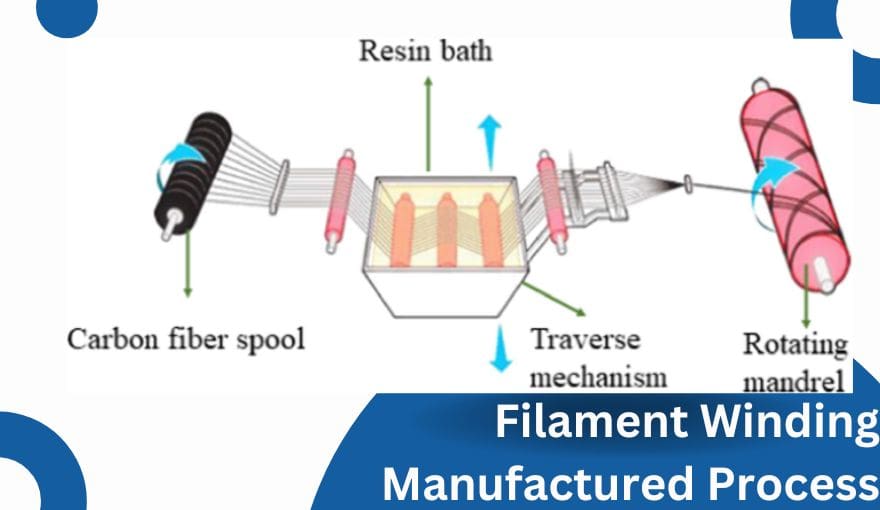
The filament winding process proceeds through six stages:
- Fiber delivery: Continuous fiber tows are unwound from spools mounted on a creel. Common fiber types include carbon fiber, glass fiber, and aramid (Kevlar). The creel holds multiple spools simultaneously to allow multi-tow winding for higher production rates.
- Resin impregnation: In wet winding, fibers pass through a resin bath where they are thoroughly saturated with a thermoset matrix — typically epoxy, polyester, or vinyl ester resin. Complete fiber wet-out at this stage is critical for structural integrity. In dry winding, pre-impregnated fibers are used and the resin bath is eliminated.
- Winding: The impregnated tows are fed through a delivery eye mounted on a carriage that traverses horizontally along the mandrel axis. The mandrel rotates while the carriage moves, depositing fibers at a precisely controlled winding angle relative to the mandrel axis. The winding angle directly determines the part’s mechanical response — low angles (near 0°) optimize axial strength; high angles (near 90°) optimize hoop strength for internal pressure resistance.
- Curing: After winding, the composite is cured in an oven or autoclave. Heat reduces resin viscosity, completes cross-linking of the thermoset matrix, and locks the fiber architecture in place. Cure temperature and dwell time are determined by the resin system.
- Mandrel removal: Once cured, the mandrel is extracted to leave a hollow composite structure. Mandrel materials and designs vary by application: collapsible metal mandrels, soluble plaster mandrels, and inflatable mandrels are all used. In some applications (certain pressure vessels, for example), the mandrel liner is retained as part of the finished structure.
- Finishing: The part is trimmed to final dimensions, flash is removed, and dimensional and quality inspection is performed. Some applications require oven post-curing to maximize resin conversion, followed by surface finishing such as painting, coating, or machining of end fittings.
Equipment of Filament Winding
A filament winding system consists of seven main components:
- Creel: A frame holding fiber spools that feeds tows to the resin bath and delivery system. Tension control at the creel is critical — fiber tension during winding directly affects void content and laminate compaction in the finished part.
- Resin bath: A container through which fiber tows pass to receive resin impregnation. Bath temperature and fiber dwell time are controlled to achieve consistent resin uptake. Used in wet winding only.
- Mandrel: The rotating core that defines the internal geometry of the finished part. Mandrels can be cylindrical, conical, or complex-profile shapes. Material selection (steel, aluminum, soluble plaster, inflatable rubber) depends on the part geometry and whether mandrel extraction is required.
- Fiber delivery system: A traversing carriage carrying the fiber delivery eye that moves in programmed patterns along the mandrel axis. The relationship between mandrel rotation speed and carriage traverse speed determines the winding angle and pattern repeatability.
- Curing equipment: Ovens for standard thermoset cure cycles; autoclaves for applications requiring higher consolidation pressure and lower void content.
- CNC control system: Modern filament winding machines use computer numerical control to synchronize mandrel rotation and carriage movement. Specialist software packages calculate fiber paths, optimize winding patterns for the target mechanical properties, and generate machine code. Common software platforms include Cadwind, FiberGraphix, and Cadfil.
- Auxiliary equipment: Tension control systems, fiber cutting and splicing systems, mandrel drive and support systems, and mandrel extraction equipment. These components support process consistency and production efficiency.
Types of Filament Winding
Wet Winding
Fibers are impregnated with liquid resin at the point of winding by passing through an open resin bath. Wet winding is the most common method due to its lower material cost and process flexibility. The main disadvantage is resin content variability and the handling of uncured liquid resin in the production environment.
Dry Winding
Pre-impregnated fiber tows (prepregs) are used, eliminating the resin bath. Resin content is precisely controlled during prepreg manufacture, improving consistency in the finished laminate. Dry winding is cleaner and produces more repeatable parts, but prepreg material costs are higher and cold storage is required to prevent premature resin cure.
Semi-Dry Winding
A hybrid approach in which fibers are impregnated and then passed through a drying stage before winding to remove solvents from the resin system. This reduces volatile content in the wound laminate compared to wet winding, lowering void content in the cured part while avoiding the cold storage requirements of full prepreg dry winding.
Thermoplastic Filament Winding
Rather than a thermoset resin that cross-links during cure, thermoplastic filament winding uses fiber tapes pre-impregnated with thermoplastic matrix materials such as PEEK, PPS, or PA. A localized heat source (laser, hot gas, or infrared) melts the thermoplastic at the point of lay-down, consolidating each layer onto the previous one in a single-pass process without a separate oven cure cycle. Thermoplastic filament winding produces recyclable parts, eliminates the need for handling liquid resins, and significantly accelerates production. The process is growing in adoption for aerospace and automotive structural components where recyclability is a design requirement.
Coreless Filament Winding
Coreless filament winding eliminates the traditional mandrel. Instead, resin-impregnated fiber tows are wound between anchor points or pin frames, with the final geometry determined by the fiber interaction in space rather than by a solid core. The technique is primarily used for large-scale architectural and structural components with complex geometries that would be impossible or prohibitively expensive to produce with a conventional mandrel. Robotic fiber placement systems and computational co-design frameworks are typically used to optimize fiber paths for the target structural performance.
Materials Used in Filament Winding
Reinforcement Fibers
- Carbon fiber: Highest strength-to-weight ratio and stiffness. Standard for aerospace, high-performance automotive, and sporting goods applications where weight is a primary design driver.
- Glass fiber: Lower cost than carbon, with good tensile strength and electrical insulation properties. The most widely used fiber in industrial filament winding — pipes, tanks, pressure vessels.
- Aramid fiber (Kevlar, Nomex): Outstanding impact resistance and tensile strength. Used in ballistic protection, aerospace secondary structures, and applications requiring fatigue resistance under repeated impact.
- Basalt fiber: Properties similar to glass fiber but with improved thermal stability and chemical resistance. Used in applications requiring service temperatures above the capability of E-glass.
Resin Systems
- Epoxy resin: Best combination of mechanical performance, adhesion, and chemical resistance. Dominant resin for aerospace and high-performance industrial applications.
- Polyester resin: Lowest cost, easiest to handle. Used in less demanding applications — general industrial pipe, storage tanks, non-pressure vessels.
- Vinyl ester resin: Better chemical and moisture resistance than polyester, approaching epoxy in corrosion resistance at lower cost. Common in chemical process piping and marine applications.
- Phenolic resin: Selected for fire, smoke, and toxicity (FST) performance in public transport and aircraft interior applications.
Factors That Affect the Strength of Filament-Wound Composite Tubes
Six factors determine the mechanical performance of filament-wound composite tubes:
- Fiber and resin type: The intrinsic mechanical properties of the chosen fiber and matrix system set the upper bound for part performance. Carbon fiber composites achieve higher stiffness and strength than glass; epoxy matrices typically outperform polyester in both mechanical properties and environmental resistance.
- Winding angle: The angle at which fibers are deposited relative to the mandrel axis is the primary design variable in filament winding. Low winding angles (near 0°) maximize axial tensile and compressive strength; high winding angles (near 90°) maximize hoop strength for internal pressure resistance. Most pressure vessels use helical winding patterns that balance both requirements, typically in the 55° range for optimum biaxial loading performance.
- Fiber tension during winding: Higher fiber tension during winding compacts the laminate, increases fiber volume fraction, and reduces void content — all of which increase strength. Tension must be controlled consistently across the winding sequence to avoid residual stress gradients in the finished laminate.
- Manufacturing process quality: Resin bath temperature, fiber dwell time, mandrel surface preparation, and cure cycle parameters all affect fiber wet-out, void content, and resin conversion. Deviations from the qualified process can reduce mechanical properties significantly.
- Environmental conditions during cure: Temperature and humidity during winding and curing affect resin viscosity, gelation time, and final degree of cure. Elevated humidity during cure of moisture-sensitive resin systems can reduce glass transition temperature and long-term mechanical performance.
- Physical dimensions: Wall thickness and diameter affect structural efficiency. Thicker walls generally increase burst pressure capacity for pressure vessels; larger diameters reduce hoop stress for the same internal pressure and wall thickness.
Strength of Filament-Wound Pressure Vessels
Filament-wound pressure vessels are among the highest-performing structural composites in commercial production. Typical mechanical properties for glass fiber/epoxy wound products designed for internal pressure service include:
- Longitudinal tensile strength: approximately 16,000 psi (110 MPa)
- Circumferential (hoop) tensile strength: approximately 40,000 psi (276 MPa)
- Longitudinal compressive strength: approximately 27,000 psi (186 MPa)
- Circumferential compressive strength: approximately 37,000 psi (255 MPa)
The significantly higher hoop strength relative to axial strength reflects the helical winding pattern used for pressure vessels, which places more fiber in the circumferential direction where internal pressure generates the highest stress (hoop stress is twice axial stress in a thin-walled cylinder under internal pressure). Carbon fiber/epoxy wound pressure vessels achieve substantially higher values — aerospace-grade composite overwrapped pressure vessels (COPVs) used in spacecraft propulsion routinely achieve burst pressures of 10,000 psi and above.
Applications of Filament Winding
- Aerospace: Rocket motor casings, composite overwrapped pressure vessels (COPVs), aircraft fuselage sections, wing spars, and fuel tanks. Space shuttle payload bay doors were among the early high-profile filament-wound aerospace structures.
- Industrial pipe and vessels: Chemical process piping, storage tanks, scrubbers, and pressure vessels for oil and gas. Filament-wound GRP (glass-reinforced plastic) pipe is widely used for corrosion-resistant fluid transport.
- Automotive: Drive shafts, suspension components, and high-performance exhaust systems. Formula 1 teams use filament-wound carbon fiber components for structural chassis elements.
- Energy: Wind turbine blade skins and structural elements; compressed hydrogen and natural gas storage cylinders for fuel cell vehicles; tidal turbine blades.
- Marine: Yacht masts and spars, boat hulls for racing vessels, and submarine pressure hull sections.
- Sports equipment: Golf club shafts, fishing rods, bicycle forks, and rowing oars.
- Infrastructure: Utility poles, street light columns, and transmission poles where corrosion resistance and light weight reduce installation and maintenance costs.
- Defense: Missile casings, rocket motor cases, and lightweight structural components for military vehicles and aircraft.
- Medical: Orthopedic implants, prosthetic limb structures, and radiolucent imaging table components.
Advantages of Filament Winding
- High strength-to-weight ratio: Precise fiber alignment and high fiber volume fractions produce structures with mechanical efficiency that metals cannot match at equivalent weight.
- Fiber orientation control: Unlike many composite processes, filament winding allows the designer to specify fiber angles throughout the laminate thickness, optimizing strength and stiffness for the specific load conditions of each application.
- Process efficiency: CNC-controlled winding machines operate continuously with minimal manual intervention, enabling high production rates for cylindrical geometries.
- Material utilization: The controlled deposition of fiber directly onto the mandrel minimizes material waste compared to cut-and-lay processes. Scrap rates below 5% are achievable in well-optimized production.
- Automation compatibility: The process is well suited to integration with robotic systems, reducing labor content and improving repeatability in high-volume production.
- Design flexibility: Winding angle, layer thickness, and fiber type can all be varied through the laminate thickness to tailor performance. Local reinforcement in high-stress zones can be added through selective over-winding.
- Corrosion resistance: Glass and carbon fiber composites are inherently resistant to a wide range of chemicals, making filament-wound structures suitable for aggressive service environments without coatings or cathodic protection.
Limitations of Filament Winding
- Geometric constraints: The standard process is best suited to convex, axisymmetric geometries. Re-entrant curves, undercuts, and concave surfaces cannot be wound with conventional equipment. Complex non-axisymmetric shapes require robotic systems and custom fiber path programming.
- Low winding angles: Fiber angles near 0° (axial direction) are mechanically challenging to produce because fibers tend to slip on the mandrel surface at low angles. Special end dome geometries or additional axial layers are typically required.
- External surface finish: The outer surface of filament-wound parts is defined by the last wound fiber layer, which typically produces a textured, resin-rich surface rather than a smooth finish. Secondary surface finishing operations add cost for applications requiring smooth external appearance.
- Interlaminar shear strength: Like most continuous fiber composites, filament-wound structures have lower interlaminar shear strength than in-plane tensile or compressive strength. Applications involving significant through-thickness shear must be carefully designed.
- Mandrel cost and complexity: For parts requiring mandrel extraction, mandrel design and fabrication can be expensive, particularly for complex internal geometries. Collapsible or soluble mandrel systems add cost and process complexity.
Comparison with Other Composite Manufacturing Techniques
Filament winding, pultrusion, and autoclave molding are the three primary continuous fiber composite manufacturing processes, each with distinct performance and geometric characteristics.
Pultrusion produces parts of constant cross-section by pulling fiber and resin through a heated die. It is highly efficient for long, straight profiles — structural sections, rods, tubes of uniform diameter — and achieves good axial fiber alignment. For axial tensile and compressive strength in prismatic sections, pultrusion and filament winding are broadly comparable. The key difference is geometric capability: pultrusion is limited to constant cross-sections, while filament winding can produce varying-diameter profiles, domed ends, and complex vessel geometries. Neither process is inherently superior; they address different structural forms.
Autoclave molding achieves the highest fiber volume fractions (60–70%) and lowest void content (<1%) of any process, producing parts with the best mechanical properties per unit weight. The trade-off is cost, cycle time, and size limitation — autoclaves are capital-intensive, cycles are slow, and vessel size limits part dimensions. Filament winding is faster, less capital-intensive, and can produce larger structures, but typically achieves somewhat lower fiber volume fractions (50–65%) than optimized autoclave processing.
The Function of the Filament Winding Mandrel
The mandrel defines the internal geometry of the finished composite part and provides the structural support against which fibers are tensioned during winding. It must withstand the compressive stress generated by fiber tension throughout the winding sequence without deflecting, and must survive the cure temperature cycle without dimensional distortion.
Mandrel materials are selected based on part geometry, production volume, and whether extraction is required. Steel and aluminum mandrels are used for high-volume production of standard cylindrical parts. Collapsible metal mandrels allow removal from closed-ended vessels. Soluble plaster or sand mandrels are used for complex internal geometries where mechanical extraction is not possible — the mandrel is dissolved with water after cure. Inflatable rubber mandrels are used for hollow structural sections where flexibility allows withdrawal. In some pressure vessel applications, a thin metal or thermoplastic liner serves as the mandrel and remains in the finished structure, functioning as both the winding tool and the fluid-tight inner barrier.
Frequently Asked Questions
What is filament winding used for?
Filament winding is primarily used to manufacture hollow, cylindrical, or pressure-containing composite structures. The most common products are industrial pipes, chemical storage tanks, pressure vessels, and rocket motor casings. The process is also used for aerospace structural components, wind turbine blade skins, drive shafts, compressed gas cylinders, yacht masts, and sporting goods such as golf shafts and fishing rods. Any application requiring a lightweight, high-strength, corrosion-resistant hollow structure is a candidate for filament winding.
What is the difference between wet winding and dry winding?
In wet winding, fibers pass through a liquid resin bath immediately before being deposited on the mandrel. It is the most common and lowest-cost method but produces more variability in resin content and requires handling of uncured liquid resin. In dry winding, pre-impregnated fiber tows (prepregs) are used — the resin is already applied and partially cured during prepreg manufacture. Dry winding produces more consistent resin content and a cleaner production environment, but prepreg materials cost significantly more and require cold storage at approximately -18°C.
What winding angle is used for pressure vessels?
Most filament-wound pressure vessels use helical winding patterns combining multiple angles. For cylindrical vessels under internal pressure, the theoretically optimal winding angle for balanced biaxial loading (hoop stress twice axial stress in a thin-walled cylinder) is approximately 54.7° — commonly rounded to 55° in practice. End domes typically use lower winding angles to provide adequate axial reinforcement. Production vessels often combine 55° helical layers with 90° hoop layers to independently optimize hoop and axial strength.
What are the main limitations of filament winding?
The primary geometric limitation is that standard filament winding is restricted to convex, axisymmetric shapes — cylinders, cones, and domed vessels. Re-entrant curves, concave surfaces, and complex non-axisymmetric geometries require robotic winding systems. Very low fiber angles (near 0°) are difficult to achieve without fiber slippage. The external surface finish is defined by the outermost fiber layer and is typically textured rather than smooth, requiring secondary finishing for appearance-critical applications. Interlaminar shear strength is also lower than in-plane strength, which must be accounted for in designs with significant through-thickness loading.
How does filament winding compare to pultrusion?
Pultrusion and filament winding are complementary rather than competing processes. Pultrusion is optimized for constant cross-section profiles — structural sections, rods, and uniform-diameter tubes — and produces excellent axial fiber alignment for prismatic parts. Filament winding is optimized for hollow, rotationally symmetric structures with varying cross-sections, domed ends, and pressure-containing geometries. For equivalent prismatic tube geometries, axial strength performance is broadly similar between the two processes. The choice depends on part geometry and load path requirements, not an inherent superiority of one process over the other.
What is thermoplastic filament winding?
Thermoplastic filament winding uses fiber tapes pre-impregnated with thermoplastic resin (such as PEEK, PPS, or PA) rather than thermoset systems. A localized heat source melts the thermoplastic at the point of lay-down, consolidating each layer onto the previous one in-process without a separate oven cure. The result is a fully consolidated part at the end of the winding cycle. Key advantages include recyclability of the finished part, elimination of liquid resin handling, faster effective cycle times, and improved impact resistance compared to brittle thermoset matrices. The process is growing in adoption for aerospace and automotive structural applications.
What fiber materials are used in filament winding?
Carbon fiber, glass fiber, aramid fiber (Kevlar), and basalt fiber are the four main reinforcement materials. Carbon fiber delivers the highest stiffness and strength-to-weight ratio and is used in aerospace, motorsport, and high-performance sporting goods. Glass fiber is the most widely used material by volume due to its lower cost and good corrosion resistance — the standard choice for industrial pipe, tanks, and pressure vessels. Aramid fiber offers exceptional impact resistance and is used in ballistic protection and fatigue-sensitive aerospace applications. Basalt fiber is occasionally used where higher temperature stability than E-glass is required at a cost below carbon fiber.
What resin systems are compatible with filament winding?
Epoxy, polyester, vinyl ester, and phenolic resins are all used in filament winding, selected based on performance requirements and cost. Epoxy provides the best mechanical properties and chemical resistance and dominates in aerospace and high-performance industrial applications. Polyester is the lowest-cost option and is used for general-purpose industrial pipe and non-pressure vessels. Vinyl ester offers better corrosion and moisture resistance than polyester at moderate cost premium, making it the standard choice for chemical process piping and marine structures. Phenolic resin is selected where fire, smoke, and toxicity (FST) performance is required, particularly in aircraft interior components and public transport applications.
Request a B2B Manufacturing Quote – Share your profile, rebar, machine, or die requirements and we will return specifications, lead time, and export pricing. Contact IncomePultrusion for a project quote.

