


Equipment selection errors in pultrusion manufacturing result in significant productivity losses and quality issues. Making informed pultrusion machine choices directly impacts manufacturing efficiency and long-term operational success.
Line integration: Match roving capacity to your fiber architecture using our
pultrusion creel layouts, then pair with a
pultrusion die and pultrusion machine package.
Ready for a B2B line quote? See our pultrusion machine manufacturing page for production line modules, capacity range, and export lead times.
Understanding Pultrusion Machine Technology
Pultrusion machines manufacture continuous fiber-reinforced polymer profiles through controlled pulling processes. The fundamental mechanism involves drawing reinforcing fibers through resin bath systems, followed by consolidation and curing in heated dies at temperatures ranging from 120°C to 180°C. This process enables the production of various FRP profiles and fiberglass structural profiles with consistent quality and dimensional accuracy.
Process parameters include production speeds of 0.5-3.0 meters per minute, with pull forces ranging from 5kN to 500kN depending on profile complexity and cross-sectional dimensions. Modern pultrusion machines maintain dimensional tolerances of ±0.1mm while processing materials that meet ASTM D3918 specifications. Understanding what is pultrusion helps manufacturers appreciate the precision required in equipment selection.
Key control parameters include fiber volume fractions of 59-65% for optimal mechanical properties and temperature uniformity within ±3°C across the profile cross-section to ensure consistent cure and minimize internal stress.
Pultrusion Machine Types and Technical Specifications
Hydraulic (Reciprocating) Pultrusion Machines
Hydraulic pultrusion machines utilize reciprocating clamps powered by hydraulic cylinders to provide intermittent pulling action. These systems generate pull forces from 5kN to 150kN and accommodate profile widths up to 300mm. For manufacturers requiring comprehensive pultrusion equipment solutions, hydraulic systems offer flexibility and cost-effectiveness.
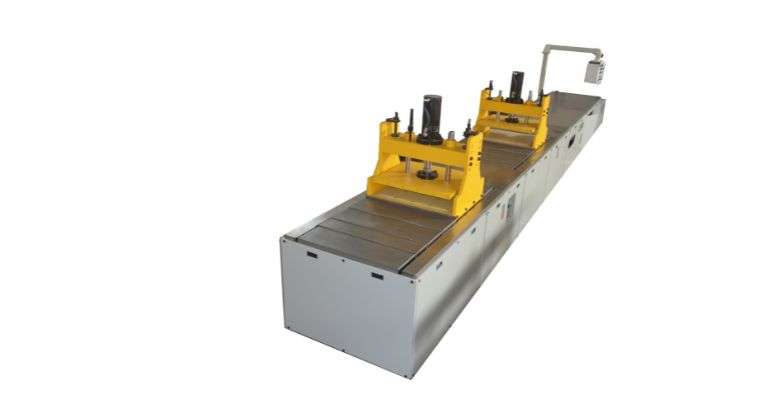
Hydraulic pultrusion machinery showing the reciprocating clamp system and control interface
Technical Specifications:
- Production capacity: 200-500 tons annually
- Pull force range: 5-150kN
- Maximum profile width: 300mm
- Changeover time: 2-4 hours
- Dimensional accuracy: ±0.3-0.5mm
- Power consumption: 15-30kW
- Initial investment: $150,000-$400,000
Operational Characteristics:
- High flexibility for diverse product portfolios
- Simplified maintenance requirements
- Reduced setup complexity for complex geometries
- Manual to semi-automatic operation capabilities
Crawler (Caterpillar) Pultrusion Machines
Crawler pultrusion machines employ continuous belt or track systems to provide consistent pulling force without interruption. These systems generate pull forces from 50kN to 500kN and handle profile widths up to 1,000mm. Advanced caterpillar pultrusion machines are specifically designed for high-volume manufacturing operations.
Technical Specifications:
- Production capacity: 500-2,000+ tons annually
- Pull force range: 50-500kN
- Maximum profile width: 1,000mm
- Production speed: 1.5-3.0 m/min
- Dimensional accuracy: ±0.1-0.3mm
- Power consumption: 25-50kW
- Initial investment: $300,000-$1,200,000
Performance Characteristics:
- Superior surface quality through continuous contact
- Enhanced dimensional consistency
- Higher throughput capabilities
- Advanced automation integration potential
Pultrusion Machine Selection Criteria
Production Volume Requirements
Annual production capacity serves as the primary selection criterion for pultrusion machines. Data analysis indicates optimal machine selection thresholds:
- <200 tons annually: Hydraulic pultrusion machines provide cost-effective solutions
- 200-1,000 tons annually: Both hydraulic and crawler technologies remain viable
- >1,000 tons annually: Crawler pultrusion machines deliver superior economics
Profile Specifications and Complexity Analysis
Profile geometry directly influences pultrusion machine selection and performance parameters. Cross-sectional area affects required pull force:
For standard glass fiber reinforced polyester profiles:
- Small profiles (<100mm²): 20-50kN
- Medium profiles (100-300mm²): 50-150kN
- Large profiles (>300mm²): 150-500kN
Complex geometries with multiple cavities require 20-30% additional pull force and reduced production speeds to maintain quality standards.
Material Processing Requirements
Different resin systems impose specific processing constraints that influence pultrusion machine selection. Understanding fiber reinforced plastic properties helps determine appropriate processing parameters:
Polyester Resins:
- Processing temperature: 140-160°C
- Optimal speed range: 0.8-2.5 m/min
- Cure time: 30-60 seconds per meter
Vinyl Ester Resins:
- Processing temperature: 160-180°C
- Optimal speed range: 0.6-2.0 m/min
- Cure time: 45-75 seconds per meter
Epoxy Resins:
- Processing temperature: 120-140°C
- Optimal speed range: 0.4-1.5 m/min
- Cure time: 60-90 seconds per meter
Common Pultrusion Machine Production Issues and Solutions
Surface Quality Problems
Blistering and Delamination:
Surface blistering results from excessive die temperature or inadequate cure. Solutions require reducing die temperature by 10-15°C and adjusting line speed to maintain cure completeness. Die temperature uniformity within ±3°C prevents localized overheating.
Fiber Show-Through:
Visible fiber patterns indicate insufficient resin content or poor wet-out. Solutions include increasing resin bath temperature to 40-50°C, improving fiber spreading mechanisms, and adjusting resin viscosity through temperature control.
Dimensional Variations:
Profile thickness variations exceeding ±0.3mm result from inconsistent pulling speed or resin viscosity fluctuations. Servo-controlled pulling systems and temperature-controlled resin delivery systems address these issues.
Process Optimization Parameters
Pull Force Optimization:
Excessive pull force causes fiber damage and surface marking, while insufficient force results in incomplete consolidation. Optimal pull force maintains 1.5-2.0 safety factor above minimum consolidation requirements.
Temperature Profile Management:
Multi-zone die heating requires careful temperature profiling:
- Pre-heating zone: 80-100°C for material conditioning
- Gelation zone: 120-140°C for initial polymerization
- Cure zone: 160-180°C for complete cross-linking
- Post-cure zone: 140-160°C for stress relief
Production Speed Balancing:
Maximum speeds require reduction based on profile complexity:
- Simple geometries: 100% of rated speed
- Complex profiles: 70-85% of rated speed
- Thick sections (>10mm): 60-80% of rated speed
Pultrusion Machine Automation and Quality Control
Automated Quality Control Systems
Modern pultrusion machines integrate inline measurement systems for continuous quality monitoring. These systems ensure that finished products like FRP square bars and FRP oval tubes meet specified dimensional tolerances and quality standards:
Dimensional Measurement:
Laser scanning systems provide ±0.05mm accuracy for real-time dimensional verification. These systems automatically adjust process parameters to maintain specifications and trigger reject systems for out-of-tolerance products.
Surface Inspection:
Vision systems detect surface defects including scratches, voids, and color variations. Automated defect classification enables process adjustment recommendations.
Process Monitoring:
Real-time data collection includes temperature profiles, pull force variations, production speed, and material consumption. Statistical process control algorithms identify trends and predict quality issues.
Automation Levels and Impact
Manual Systems:
- Require 2-3 operators per shift
- Suitable for volumes under 300 tons annually
- Lower initial investment but higher labor costs
Semi-Automatic Systems:
- Require 1-2 operators per shift
- Include automated cutting and material handling
- Balance automation benefits with operational control
Fully Automated Systems:
- Require minimal operator intervention
- Include predictive maintenance capabilities
- Reduce labor costs by up to 60% while improving consistency
Complete pultrusion production lines integrate all these automation features for maximum efficiency and quality control. Advanced systems often include automatic profile cutting machines for precision downstream processing.
Pultrusion Machine Supplier Evaluation
Technical Capabilities Assessment
Supplier selection requires evaluation of engineering capabilities. Established manufacturers like IncomePultrusion provide comprehensive pultrusion technology services and equipment for the complete manufacturing process:
Process Development Support:
Qualified suppliers provide finite element analysis for complex die designs, material compatibility testing, and process optimization services. Pilot testing facilities enable process validation before implementation.
Training Programs:
Comprehensive training programs should include 40-80 hours of operator instruction, 80-120 hours for maintenance technicians, and ongoing technical support.
Service Requirements
Response Time Specifications:
- Critical failures (production stoppage): 4-8 hour response, 24-48 hour resolution
- Quality issues: 24-hour response, 72-hour resolution
- Performance optimization: 48-hour response, one-week resolution
Technical Support Infrastructure:
- 24/7 remote diagnostic capability
- Local service technicians within 200km radius
- 5-year spare parts availability guarantee
- Annual on-site preventive maintenance programs
Supplier Assessment Criteria
Technology Capabilities:
Evaluate supplier investment in pultrusion machine technology development. Suppliers should demonstrate minimum 5-8% revenue investment in research and development. Leading manufacturers provide complete solutions including specialized equipment for specific applications like FRP handrail profiles and fiberglass tool handles.
Financial Stability:
Assess supplier financial stability through market presence duration (minimum 10-15 years) and reference customer installations with 5+ year operational history.
Pultrusion Machine Cost Analysis and ROI
Total Cost of Ownership
Capital Investment Components:
- Base machine cost: $150,000-$1,200,000
- Installation and commissioning: 10-15% of machine cost
- Tooling and dies: $20,000-$100,000 per profile
- Training and startup: $10,000-$30,000
- Initial spare parts: 5-8% of machine cost
Operating Cost Analysis:
- Energy consumption: 15-50kW depending on system type
- Maintenance costs: 3-5% of machine cost annually
- Labor requirements: Variable based on automation level
- Material efficiency: 5-15% waste rates depending on process control
The selection of appropriate pultrusion machine technology also impacts the range of products that can be manufactured, from basic structural elements to specialized applications. Complete equipment for the pultrusion process includes auxiliary systems that affect overall operational costs and product quality.
ROI Calculation Framework
Productivity Benefits:
- Labor cost reduction through automation: 50-70%
- Quality improvement impact: 30-50% defect reduction
- Energy efficiency gains: 15-25% consumption reduction
- Throughput increases: 20-35% for automated systems
Payback Period Analysis:
High-volume operations (>1,500 tons annually) typically achieve 18-24 month payback periods, while medium-volume operations (500-1,500 tons annually) require 24-36 months for return on investment.
Decision Support Matrix
| Application Category | Profile Dimensions | System Type | Pull Force | Speed Range | Investment Range |
|---|---|---|---|---|---|
| Custom Components | <50mm width | Hydraulic | 20-50kN | 0.5-1.5 m/min | $150k-$300k |
| Standard Profiles | 50-200mm width | Hydraulic/Crawler | 50-150kN | 1.0-2.5 m/min | $200k-$600k |
| Structural Elements | 200-500mm width | Crawler | 150-300kN | 1.5-3.0 m/min | $400k-$800k |
| Heavy Industrial | >500mm width | Crawler | 300-500kN | 0.8-2.0 m/min | $600k-$1200k |
Frequently Asked Questions
What pull force specifications are required for different profile applications?
Pull force requirements depend on profile cross-sectional area and material properties. Standard glass fiber polyester profiles require 20-50kN for small sections (<100mm²), 50-150kN for medium sections (100-300mm²), and 150-500kN for large structural profiles (>300mm²). Carbon fiber applications typically require 25% higher pull forces.
How do temperature control requirements vary between resin systems?
Different resin systems require specific temperature profiles. Polyester resins process at 140-160°C, vinyl esters at 160-180°C, and epoxies at 120-140°C. Temperature uniformity within ±3°C across the die cross-section prevents cure variations and internal stress development.
What maintenance intervals are recommended for pultrusion machines?
Preventive maintenance schedules include daily inspections (15 minutes), weekly lubrication and calibration (2 hours), monthly comprehensive checks (4 hours), quarterly major services (8 hours), and annual overhauls (40 hours). Regular maintenance ensures optimal performance and extends equipment life.
How do automation levels affect pultrusion machine efficiency?
Full automation reduces labor requirements by 50-70% while improving dimensional consistency by 30-50%. Automated systems enable continuous operation and reduce human error in process control. Initial investment increases by 20-40% compared to manual systems.
What energy efficiency improvements are achievable with modern pultrusion machines?
Servo-driven systems reduce energy consumption by 15-25% compared to hydraulic alternatives. Heat recovery systems provide additional 20-30% savings through waste heat utilization. LED heating elements offer 40-50% efficiency improvements over traditional resistance heating.
How do changeover times compare between hydraulic and crawler pultrusion machines?
Hydraulic pultrusion machines typically require 2-4 hours for profile changeovers, while crawler systems need 4-8 hours due to more complex setup procedures. Quick-change tooling systems can reduce these times by 50% through standardized interfaces.
What quality monitoring capabilities are available for pultrusion machines?
Modern pultrusion machines integrate laser dimensional measurement (±0.05mm accuracy), vision systems for surface defect detection, thermal imaging for temperature monitoring, and real-time pull force tracking. Data integration enables statistical process control and automatic quality adjustment.
How should recycled materials be processed in pultrusion machines?
Processing recycled fibers requires enhanced spreading systems and contamination control. Bio-based resins need modified temperature control and injection systems. Equipment should accommodate 20-40% recycled content while maintaining quality standards through advanced process monitoring. Modern pultrusion machines are increasingly designed to handle sustainable material inputs while maintaining product quality and performance specifications.
Conclusion
Pultrusion machine selection requires systematic evaluation of production requirements, technical specifications, and operational objectives. The primary decision between hydraulic and crawler technologies depends on production volume, with 1,000 tons annually serving as the critical threshold.
Technical considerations including pull force requirements, dimensional accuracy specifications, and material compatibility directly influence pultrusion machine performance and operational efficiency. Quality requirements demanding ±0.2mm tolerances necessitate crawler systems with advanced control capabilities, while diverse product portfolios benefit from hydraulic system flexibility.
Supplier evaluation must encompass technical capabilities, service infrastructure, and long-term support potential. Comprehensive service agreements ensuring 24-48 hour response times and 5-year parts availability prove essential for maintaining production continuity.
Economic analysis should focus on total cost of ownership rather than initial capital investment. Automated systems providing 50-70% labor reduction and 30-50% quality improvement typically achieve 18-36 month payback periods depending on production volume and application requirements.
The selection of appropriate pultrusion machine technology requires careful consideration of specific manufacturing requirements, quality standards, and long-term operational goals to ensure optimal return on investment and manufacturing efficiency.
Request a B2B Manufacturing Quote – Share your profile, rebar, machine, or die requirements and we will return specifications, lead time, and export pricing. Contact IncomePultrusion for a project quote.

