


Vacuum bagging is a composite consolidation technique that uses atmospheric pressure as a uniform clamping force to compact fiber reinforcement and resin during cure. It occupies the middle ground in the composite manufacturing hierarchy: more consistent and controllable than open hand layup, less capital-intensive than autoclave processing, and applicable to a wider range of part sizes and geometries than press molding. This article covers how vacuum bagging works, the function of each consumable material in the bag stack, process parameters, performance compared to alternative consolidation methods, and the applications where it is most commonly specified.
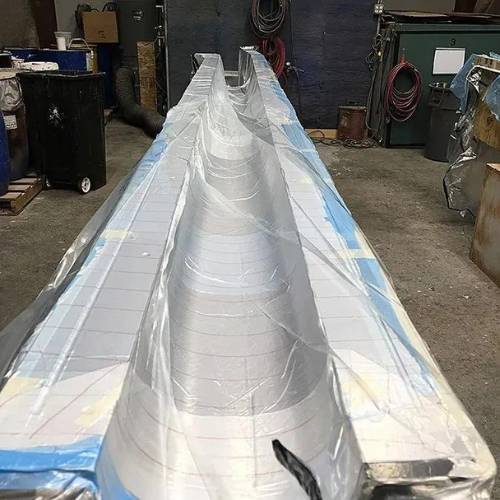
How Vacuum Bagging Works
The operating principle is straightforward. A composite layup — either wet layup with liquid resin or prepreg — is sealed inside an airtight flexible film bag. A vacuum pump evacuates air from inside the bag, reducing internal pressure to typically 25–75 mbar absolute (equivalent to 720–740 mmHg vacuum). Atmospheric pressure outside the bag — 101.3 kPa (14.7 psi) at sea level — then acts uniformly across the entire bag surface, compacting the laminate against the mold.
This compaction pressure serves several simultaneous functions: it consolidates fiber plies together, reducing interlaminar voids; it drives excess resin out of the laminate through the release film and into the breather layer, improving fiber volume fraction; and it holds the laminate in contact with the mold surface during cure, ensuring dimensional accuracy and surface finish on the tool side of the part.
The maximum consolidation pressure available from vacuum bagging is limited to one atmosphere — 101.3 kPa at sea level — because the pressure differential cannot exceed the ambient atmospheric pressure. This is the fundamental limitation that distinguishes vacuum bagging from autoclave processing, where additional pressurized gas above atmospheric brings total consolidation pressure to 300–700 kPa for aerospace-grade laminates.
Bag Stack Materials and Their Functions
A vacuum bag assembly consists of several layers, each serving a specific function. The correct selection and sequencing of these materials directly affects laminate quality.
Peel ply is a woven nylon or polyester fabric placed directly against the laminate surface. It releases cleanly from the cured part, leaving a textured surface profile on the laminate that provides a mechanical key for secondary bonding or painting without additional abrasion. Peel ply selection affects the surface texture left on the part — tighter weave fabrics leave finer texture, coarser fabrics leave more pronounced texture. Peel ply does not control resin flow.
Release film (perforated or non-perforated FEP or nylon film) sits above the peel ply and controls resin bleed. Perforated release film allows excess resin to migrate out of the laminate into the breather layer during cure, which increases fiber volume fraction and reduces resin-rich zones. Non-perforated release film prevents resin bleed entirely and is used when resin content must be maintained — typically with prepreg systems where the resin content is already controlled at manufacture. Perforation pattern and hole size determine bleed rate; finer perforations reduce bleed rate, coarser perforations increase it.
Breather cloth is a non-woven polyester or nylon fabric that provides an air evacuation path across the entire bag area. Without breather cloth, the vacuum pump would only evacuate air adjacent to the vacuum port, leaving areas of the bag at higher pressure. Breather cloth must maintain its loft and air permeability throughout the cure cycle — some breather materials compress excessively at high temperatures and lose their evacuation function. For wet layup with significant resin bleed, the breather also absorbs excess resin; its capacity must be matched to the expected bleed volume.
Vacuum bag film is the outermost layer that forms the airtight enclosure. Nylon bag film is standard for room-temperature and 120°C cure cycles. High-temperature nylon or polyimide (Kapton) film is required for cure temperatures above 150°C — standard nylon bag film softens and loses integrity at elevated temperatures and cannot be used for 180°C cure prepreg systems. PVA film is used in some marine and low-temperature applications. Bag film thickness affects conformability to complex geometry — thinner films (50–75 μm) conform better to tight radii and complex surfaces; thicker films (100–150 μm) are more puncture-resistant for large parts with hardware or rough edges.
Sealant tape (tacky tape) bonds the bag film to the mold flange, forming the airtight perimeter seal. Butyl rubber sealant tape is standard. The seal is the most common source of vacuum leaks — proper surface preparation of the mold flange, adequate tape coverage, and careful bag film attachment are the primary process controls for leak prevention.
Process Procedure
Mold preparation begins with surface cleaning and release agent application. The mold surface must be free of contamination that would inhibit release or compromise the tool-side surface finish of the part. Release agents — either semi-permanent polymer systems applied in multiple coats or single-use wax systems — must be fully cured before layup begins; uncured release agent contaminates the resin and reduces bond strength in secondary bonded assemblies.
Layup proceeds with dry fabric infusion or prepreg placement depending on the resin system. For wet layup, resin is applied by brush or roller to each fabric layer as it is placed; for prepreg, the tacky pre-impregnated material is applied directly. Ply orientation must be verified against the design layup sequence at each layer. Air entrapment between plies is reduced by rolling each ply firmly before the next is placed.
Bag assembly sequencing — peel ply, release film, breather, bag film — is applied over the completed layup. Vacuum ports are positioned at the highest points of the part geometry and at locations away from the laminate edge to avoid resin contamination of the port fitting. For large or complex parts, multiple vacuum ports connected to a manifold ensure uniform evacuation across the full part area.
Vacuum is drawn and held for a leak check before cure begins. The standard leak check procedure is to draw full vacuum, isolate the pump by closing the valve, and monitor pressure rise over 5–10 minutes. A pressure rise of less than 5 mbar over 5 minutes is typically the acceptance criterion for structural parts. Leaks are located by listening for air ingress, applying soapy water around the bag perimeter and port fittings, or using an ultrasonic leak detector for small leaks on large parts. All leaks must be resolved before cure — a leak that develops during the cure cycle cannot be repaired without interrupting and potentially scrapping the part.
Cure proceeds either at room temperature (for room-temperature cure resin systems) or in an oven at the resin system’s specified cure temperature. Vacuum must be maintained throughout the cure cycle; vacuum pump failure during cure results in incomplete consolidation and elevated void content. For critical applications, a vacuum reservoir and check valve provide short-term vacuum maintenance in the event of pump interruption.
Performance Compared to Hand Layup and Autoclave
Vacuum bagging consistently outperforms open hand layup on the metrics that determine structural composite quality. Fiber volume fraction in hand layup typically falls in the range of 35–50% depending on operator skill and resin application control. Vacuum bagging with perforated release film and controlled bleed raises fiber volume fraction to 50–65%, directly increasing stiffness and strength proportional to the additional fiber content. Void content in hand layup is typically 3–8%; vacuum bagging reduces this to 1–3% under good process control. The tensile and compressive strength improvement from this combination — higher fiber volume fraction and lower void content — is typically 10–20% over equivalent hand layup, though the improvement varies with laminate thickness, resin system, and operator baseline.
Autoclave processing provides higher consolidation pressure — typically 300–700 kPa total — which further reduces void content to below 1% and improves fiber volume fraction to 60–70% in aerospace prepreg systems. For parts where void content below 1% and fiber volume fraction above 60% are required by specification — primary aerospace structure, for example — autoclave processing is necessary and vacuum bagging is not an adequate substitute. For the majority of structural composite applications in marine, construction, wind energy, and automotive, vacuum bagging provides sufficient quality at substantially lower capital and operating cost than autoclave processing.
Applications
Vacuum bagging is the standard consolidation method for composite parts where hand layup quality is insufficient but autoclave capital investment is not justified. Marine hull and deck construction uses vacuum bagging for primary structural laminates where consistent fiber volume fraction across large curved surfaces is required and autoclave access is impractical for boat-scale parts. Wind turbine blade manufacture uses vacuum infusion — a variant of vacuum bagging where resin is drawn into dry fiber under vacuum rather than pre-applied — for blade skins and spar caps where the part scale makes prepreg handling impractical. Automotive composite body panels and structural components use vacuum bagging for prototype and low-volume production where press tooling cost is not justified. Aerospace secondary structure — fairings, interior panels, access doors — is produced by vacuum bagging with prepreg where autoclave processing is reserved for primary structure. Sporting goods and industrial applications where performance requirements exceed what hand layup can deliver but production volumes are too low for press molding use vacuum bagging as the standard process.
Process Limitations
Consolidation pressure is limited to one atmosphere, which is insufficient for void content requirements below 1% or fiber volume fractions above 65% in most resin systems. Bag setup is labor-intensive and generates significant consumable waste — bag film, breather cloth, release film, and sealant tape are single-use materials on most parts. Bag leaks during cure are a process risk that requires reliable leak detection procedures and trained operators to manage. Very large parts require careful breather layout and multi-port vacuum systems to ensure uniform evacuation; areas of poor breather contact or blocked evacuation paths produce locally elevated void content that may not be detected without full-area ultrasonic inspection. Room-temperature cure under vacuum is slower than press or autoclave cure and may require post-cure heating to achieve full resin crosslinking for elevated-temperature service.
Frequently Asked Questions
What consolidation pressure does vacuum bagging apply?
Vacuum bagging applies a maximum of one atmosphere — 101.3 kPa (14.7 psi) at sea level. This is the pressure differential between the evacuated bag interior and the surrounding atmosphere. At higher altitudes, atmospheric pressure is lower and the available consolidation pressure decreases proportionally. Autoclave processing supplements vacuum with pressurized gas, bringing total consolidation pressure to 300–700 kPa for applications where one atmosphere is insufficient to meet void content or fiber volume fraction requirements.
What void content does vacuum bagging achieve?
Vacuum bagging under good process control — full vacuum of 25–75 mbar absolute, no leaks during cure, correct breather and release film selection — typically achieves void content of 1–3% by volume. This compares to 3–8% for open hand layup and below 1% for autoclave-processed prepreg. Void content above 2% disproportionately reduces compressive strength and interlaminar shear strength relative to tensile properties, making void content a critical quality parameter for parts under compressive or shear loading.
What is the difference between perforated and non-perforated release film?
Perforated release film allows excess resin to bleed out of the laminate into the breather layer during cure, increasing fiber volume fraction and reducing resin-rich zones. It is used with wet layup systems where resin content is applied in excess of the target fiber volume fraction. Non-perforated release film prevents resin bleed and is used with prepreg systems where resin content is already controlled at manufacture — bleeding prepreg resin removes resin that is needed for full wet-out and reduces laminate quality. Selecting the wrong release film type is a common process error: bleeding a prepreg system produces resin-starved laminates; not bleeding a wet layup system produces resin-rich, low-fiber-volume laminates.
What bag film is required for high-temperature cure cycles?
Standard nylon bag film is rated for cure temperatures up to approximately 120–135°C depending on grade. For 180°C cure prepreg systems — common in aerospace epoxy applications — high-temperature nylon or polyimide (Kapton) film must be used. Standard nylon bag film softens and loses dimensional stability above its temperature limit, resulting in bag failure during cure. Sealant tape selection must also be matched to cure temperature; some tacky tape formulations lose adhesion at elevated temperatures and allow bag leaks to develop during the cure cycle.
How is a vacuum bag leak detected and located?
The standard leak check procedure is to draw full vacuum, close the isolation valve between the pump and the bag, and monitor pressure rise over 5–10 minutes. A pressure rise of more than 5 mbar over 5 minutes indicates a leak requiring correction before cure. Leak location methods include listening for air ingress around the bag perimeter, applying soapy water to the sealant tape line and port fittings and observing bubble formation, and using an ultrasonic leak detector for small leaks on large parts where audible detection is impractical. All leaks must be resolved before cure begins — a leak that develops during the cure cycle results in locally elevated void content and potential part rejection.
Is vacuum bagging suitable for large parts?
Vacuum bagging is used on very large parts — wind turbine blade skins exceed 50 meters — but large part size requires more careful bag design. Multiple vacuum ports connected to a manifold are necessary to ensure uniform evacuation across the full part area; a single port on a large part cannot evacuate remote areas through the breather fast enough to prevent localized pressure gradients. Breather cloth layout must provide continuous air paths from all areas of the part to the vacuum ports. Large bag assemblies also increase the probability of leak development, requiring more thorough leak checking and more experienced operators to achieve consistent results.
Request a B2B Manufacturing Quote – Share your profile, rebar, machine, or die requirements and we will return specifications, lead time, and export pricing. Contact IncomePultrusion for a project quote.

