


Last updated: September 2026
Vacuum infusion is a composite manufacturing technique that uses atmospheric pressure differential — rather than mechanical force or manual resin application — to drive resin into a dry fiber layup sealed under vacuum. The process produces high fiber volume fractions, low void content, and consistent resin distribution with significantly lower volatile organic compound (VOC) emissions than open-mold wet lay-up. From aerospace structures to wind turbine blades and marine hulls, vacuum infusion has become one of the dominant processes for large, complex composite parts where quality and environmental performance both matter.
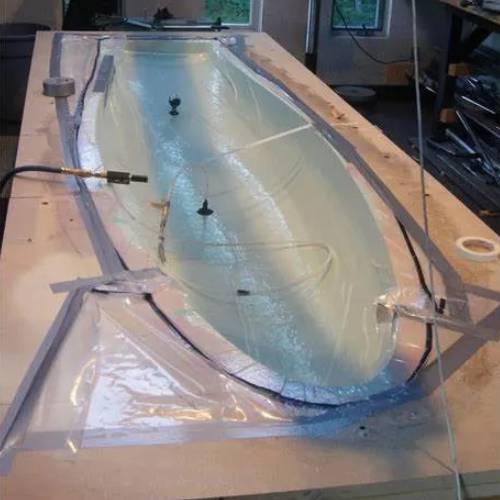
What Is Vacuum Infusion?
Vacuum infusion, also known as resin infusion or the Vacuum Infusion Process (VIP), is a manufacturing process for producing composite materials in which resin is drawn into a dry fiber preform under vacuum pressure rather than being applied manually or injected mechanically. Dry reinforcement fibers are laid into a mold, sealed under a vacuum bag, and connected to both a vacuum pump and a resin supply. When vacuum is applied, atmospheric pressure drives the resin through the fiber stack, impregnating the laminate without manual intervention. The result is a strong, lightweight composite part with controlled resin content and minimal waste.
What Is the Origin of Vacuum Infusion?
The Vacuum Infusion Process traces its origins to 1946, when Scott Bader in the United Kingdom developed the technique — marketed under the name Crystic Vacuum Infusion (Crystic VI). The development aimed to optimize the fiber-to-resin ratio by using vacuum pressure to drive resin into the laminate, improving mechanical performance compared to hand lay-up. The process remained a specialist technique for several decades before industrial adoption accelerated in the 1990s, driven by the wind energy and marine industries’ need to produce large, high-quality composite structures efficiently.
What Is the Principle of Vacuum Infusion?
The driving force in vacuum infusion is the pressure differential between the vacuum inside the sealed mold and atmospheric pressure outside. When the vacuum pump evacuates air from the mold cavity, absolute pressure inside drops to approximately 0.1 bar (near-perfect vacuum), while atmospheric pressure outside remains at approximately 1 bar. This 0.9 bar differential pushes resin from the supply line through the fiber preform, impregnating the laminate from one side to the other.
Three material properties govern the speed and completeness of resin flow: the permeability of the fiber reinforcement (how easily resin can flow through the stack), the viscosity of the resin (lower viscosity flows faster and penetrates more completely), and the thickness and architecture of the laminate. Optimizing the interaction of these three factors — through resin line placement, flow media selection, and infusion sequence design — is the core skill in vacuum infusion process engineering.
What Is the Vacuum Infusion Process?
- Material preparation and layup: Dry fiber reinforcements — glass, carbon fiber, or aramid — and any core materials are laid into the mold in the specified sequence. A release film is applied to the mold surface to prevent adhesion.
- Flow media placement: A distribution mesh or flow medium is placed over the fiber stack to promote rapid resin distribution across the part surface before it penetrates through the laminate thickness.
- Sealing: A vacuum bagging film is placed over the entire layup and sealed to the mold flange with sealant tape, creating an airtight cavity. Resin inlet lines and vacuum outlet lines are positioned and connected through the bag.
- Vacuum application: The vacuum pump draws air from the mold cavity, compacting the fiber stack and establishing the pressure differential. The vacuum level is checked for leaks before resin is introduced.
- Resin infusion: The resin inlet is opened and atmospheric pressure drives resin into the fiber preform. The operator monitors flow front progression and adjusts inlet and outlet positions as needed to ensure complete wet-out without dry spots.
- Curing: Once the resin has fully impregnated the laminate, inlet lines are clamped and vacuum is maintained throughout cure to prevent air re-entry. Cure takes place at room temperature or with applied heat depending on the resin system.
- Demolding: After cure, the vacuum bag materials, flow media, and release film are removed and the cured composite part is demolded.
What Are the Different Types of Vacuum Infusion?
Vacuum infusion encompasses a family of related processes that share the principle of vacuum-driven resin impregnation but differ in tooling, pressure conditions, and specific applications.
- Standard Vacuum Infusion Process (VIP): The baseline process described above — dry fiber in a one-sided mold, sealed under a flexible vacuum bag, with resin drawn in under atmospheric pressure differential.
- Vacuum-Assisted Resin Transfer Molding (VARTM): Similar to VIP but uses a matched rigid mold on both sides rather than a flexible bag on one side. Vacuum assists resin transfer through the closed mold, improving dimensional control on both surfaces.
- Seemann Composite Resin Infusion Molding Process (SCRIMP): An early proprietary infusion process that standardized the use of a distribution medium to accelerate resin flow across large parts. It established many of the flow media and infusion line placement strategies now used across the industry.
- Resin Film Infusion (RFI): A resin film is placed within the mold rather than supplied through inlet lines. During cure, the film melts and infuses into the adjacent fiber layers under vacuum and heat.
- Modified Vacuum Infusion (MVI): Developed by Airbus for aerospace structural applications, this variant adjusts infusion parameters and tooling details for the high fiber volume fractions and quality standards required in aircraft structures.
- Double Bag Infusion: Uses two vacuum bags — an inner bag at near-atmospheric pressure and an outer bag at full vacuum — to apply controlled compaction pressure during infusion, improving fiber volume fraction and surface quality.
- Resin Transfer Molding (RTM): Although related to the liquid composite molding family, RTM is a distinct process — resin is injected under positive pressure into a closed rigid mold rather than being drawn in under vacuum. RTM Light, a low-pressure variant using semi-rigid tooling with vacuum assistance, sits closer to vacuum infusion in process character.
Materials and Equipment Used in Vacuum Infusion
Resins
Resin selection for vacuum infusion is primarily governed by viscosity — the resin must be fluid enough to flow through the fiber preform under the available pressure differential before gelation begins. Typical target viscosity is below 500 mPa·s at infusion temperature.
- Epoxy resin: The preferred choice for high-performance applications including aerospace, automotive, and structural marine. Epoxy offers the best combination of mechanical properties, low shrinkage, good fiber adhesion, and chemical resistance. Infusion-grade epoxy systems are formulated with low viscosity and extended pot life to allow complete wet-out of large parts before gelation. The trade-off is higher material cost and longer cure times compared to polyester.
- Vinyl ester resin: Offers better moisture and chemical resistance than polyester at a moderate cost premium. Widely used in marine hull construction, chemical storage tanks, and infrastructure applications where corrosion resistance is required but full epoxy performance is not needed.
- Polyester resin: The most economical option, suitable for less demanding marine, industrial, and recreational applications. Polyester has higher VOC emissions than epoxy even in closed infusion processes, and its lower mechanical performance and higher shrinkage on cure limit use in high-performance structural applications.
Fiber Reinforcements
- Glass fiber: The most widely used reinforcement in vacuum infusion, offering good strength, corrosion resistance, and cost-effectiveness for marine, wind energy, and industrial applications.
- Carbon fiber: Used where maximum stiffness-to-weight ratio is required — aerospace structures, high-performance marine, and motorsport. Higher material cost and lower permeability than glass require more careful infusion sequence design.
- Aramid fiber: Selected for impact resistance and ballistic protection applications.
Core Materials
Sandwich construction — thin composite face skins over a lightweight core — is common in vacuum infusion for achieving high bending stiffness at low weight. Core materials include balsa wood, PVC foam, PET foam, and polyurethane foam. Cores used in infusion typically have grooved or perforated surfaces to allow resin to flow through and around the core without creating dry zones at the skin-core interface.
Process Consumables and Equipment
- Vacuum bagging film: Flexible polymer film sealed over the mold to create the vacuum envelope. Must be compatible with the resin system and able to withstand cure temperatures.
- Flow media (distribution mesh): A coarse plastic mesh placed over the fiber stack to promote rapid in-plane resin distribution before through-thickness penetration.
- Release film and peel ply: Placed between the fiber stack and flow media. Release film separates the flow media from the part; peel ply improves surface texture for secondary bonding.
- Sealant tape: Tacky putty tape that seals the vacuum bag to the mold flange, maintaining the airtight envelope.
- Vinyl tubing and connectors: Resin inlet and vacuum outlet lines. Tubing must maintain shape under vacuum without collapsing.
- Resin catch pot: Placed in the vacuum line between the mold and vacuum pump to collect excess resin and prevent pump damage.
- Vacuum pump: Typically a single-stage rotary vane pump capable of achieving vacuum levels below 50 mbar. Pump sizing depends on mold volume and acceptable leak rate.
What Are the Key Features of Vacuum Infusion?
- High fiber-to-resin ratio: Vacuum compaction of the dry preform before infusion, combined with controlled resin supply, produces fiber volume fractions of 50–60% — significantly higher than hand lay-up (35–45%).
- Low void content: The vacuum environment removes air from the laminate before and during infusion, minimizing entrapped voids. Well-executed vacuum infusion consistently achieves void content below 1–2%.
- Controlled resin usage: Resin is metered by the volume of the preform and the available pressure differential, producing repeatable resin content across production batches and enabling accurate material cost forecasting.
- Reduced VOC emissions: The closed mold environment substantially reduces styrene and solvent emissions compared to open wet lay-up, improving worker health conditions and regulatory compliance.
- One-sided tooling: Standard vacuum infusion requires only a single rigid mold surface, significantly reducing tooling cost compared to matched-mold processes like RTM. The bag side of the part has a rougher finish than the tool side.
- Large part capability: Vacuum infusion is particularly well suited to large parts — wind turbine blades exceeding 80 meters, ship hull sections, and bridge deck panels — where the scale makes alternative closed-mold processes impractical.
- Process risk: Once infusion begins, errors are difficult to correct. Dry spots, resin starvation, and vacuum leaks that develop mid-infusion typically result in scrapped parts. Setup quality is the primary determinant of success.
What Are the Applications of Vacuum Infusion?
- Wind energy: Wind turbine blade manufacturing is the largest single application of vacuum infusion by volume. Blades reaching 80+ meters in length are infused as single pieces to avoid bonded joints, requiring precise flow front management across very large part areas.
- Marine: Hull and deck structures for sailing yachts, powerboats, and commercial vessels are routinely infused, taking advantage of the process’s ability to produce large complex shapes with consistent wall thickness and low void content.
- Aerospace: Secondary and some primary structural components — fairings, control surfaces, interior panels — are produced by vacuum infusion variants including VARTM and MVI. Aerospace applications require particularly tight control of fiber volume fraction and void content.
- Automotive and motorsport: Body panels, structural floor sections, and aerodynamic components for high-performance vehicles are produced by vacuum infusion where part geometry is too complex for filament winding and production volumes are too low to justify RTM tooling investment.
- Infrastructure: Bridge deck panels, railway platform components, and large structural enclosures benefit from vacuum infusion’s ability to produce corrosion-resistant composite structures at large scale with single-sided tooling.
- Industrial: Chemical storage tanks, pressure vessel heads, and large-diameter pipe fittings that exceed the capacity of filament winding equipment are produced by infusion.
What Are the Limitations of Vacuum Infusion?
- Complex setup: Vacuum and resin line placement, bag sealing, and flow media configuration all require careful engineering before infusion begins. A single vacuum leak or poorly positioned resin inlet can compromise the entire part.
- Limited mid-process correction: Once resin flow begins, the process is largely committed. Dry spots identified during infusion can sometimes be addressed by adding resin inlet points, but major flow problems typically cannot be corrected and result in scrapped parts.
- Trial and error for new parts: Establishing the correct infusion sequence, line placement, and resin volume for a new part geometry often requires multiple trial runs. Process development cost and time must be factored into new part introduction planning.
- Material compatibility constraints: The resin must have sufficiently low viscosity to flow through the specific fiber and core combination within the available pot life. Not all high-performance resin systems are suitable for vacuum infusion without heating to reduce viscosity.
- One-sided surface quality: The bag side of an infused part has a rougher finish than the tool side. Applications requiring smooth surfaces on both faces need either secondary finishing or a matched-mold process such as RTM.
- Environmental sensitivity: Temperature affects resin viscosity and pot life. High ambient temperatures accelerate gelation, reducing the time available for resin to reach all areas of the preform. Cold temperatures increase viscosity and slow infusion. Process conditions must be controlled, particularly for large parts with long infusion times.
- High consumable cost: Vacuum bags, flow media, peel ply, sealant tape, and tubing are single-use materials that add cost per part compared to open-mold processes. For small production runs, consumable cost per part can be significant.
Frequently Asked Questions
What is the difference between vacuum infusion and vacuum bagging?
Vacuum bagging seals a wet lay-up (resin already applied manually to the fibers) under a vacuum bag to compact the laminate and remove excess resin and air during cure. Vacuum infusion starts with dry fibers — no resin is applied before bagging. The vacuum draws resin into the dry preform after the bag is sealed. Vacuum infusion produces higher fiber volume fractions and more consistent resin distribution than vacuum-bagged wet lay-up, but requires more precise setup and process control.
What resin viscosity is required for vacuum infusion?
Resin viscosity for vacuum infusion should generally be below 500 mPa·s at infusion temperature to allow adequate flow through the fiber preform within the available pot life. Many infusion-grade epoxy systems are formulated to 200–400 mPa·s at room temperature. Polyester and vinyl ester resins for infusion are similarly low-viscosity formulations. If a resin is too viscous at room temperature, gentle heating of the resin or the mold can reduce viscosity to an acceptable range, but this also accelerates gelation and shortens the working window.
What causes dry spots in vacuum infusion?
Dry spots — areas where resin has not fully impregnated the fiber — are typically caused by incorrect resin inlet or vacuum outlet placement, inadequate flow media coverage, resin gelation before the flow front reaches all areas of the part, vacuum leaks that reduce the available pressure differential, or areas of the preform with locally lower permeability such as thick sections or tight radii. Prevention relies on process design: flow simulation, trial infusions on representative sections, and careful monitoring of flow front progress during the infusion run.
Is vacuum infusion suitable for carbon fiber parts?
Yes, but carbon fiber preforms are less permeable than equivalent glass fiber layups, which slows resin flow and increases the risk of dry spots in large or thick parts. Infusion-grade carbon fiber fabrics are available with architectures (such as non-crimp fabrics with stitching) that improve in-plane permeability. Flow media and careful inlet placement are more critical for carbon than for glass. High-performance carbon fiber aerospace parts produced by vacuum infusion variants such as VARTM and MVI demonstrate that the process is fully capable of meeting aerospace quality standards with appropriate process development.
How does vacuum infusion compare to resin transfer molding (RTM)?
Vacuum infusion uses a one-sided rigid mold and a flexible vacuum bag, driving resin under atmospheric pressure differential (approximately 1 bar maximum). RTM uses a matched pair of rigid molds and injects resin under positive pressure (typically 2–10 bar), which is faster and produces controlled surface finish on both mold faces. Vacuum infusion has much lower tooling cost — only one rigid mold surface is required — making it better suited to large parts and lower production volumes. RTM is preferred for smaller, higher-volume parts where the investment in matched tooling is justified by cycle time and surface quality requirements.
What fiber volume fraction does vacuum infusion achieve?
Well-executed vacuum infusion typically achieves fiber volume fractions of 50–60%, compared to 35–45% for hand wet lay-up and 60–70% for autoclave-cured prepreg. The fiber volume fraction in vacuum infusion is primarily limited by the maximum compaction pressure available — approximately 1 bar from atmospheric pressure — which is lower than the 3–7 bar applied in an autoclave. Using double-bag infusion or elevated infusion pressure can push fiber volume fraction toward the upper end of the range for demanding applications.
What are the main consumables used in vacuum infusion?
The primary consumables are vacuum bagging film (the flexible envelope sealed over the mold), sealant tape (the tacky putty that seals the bag to the mold flange), peel ply (a release fabric bonded to the part surface for secondary bonding preparation), flow media or distribution mesh (a coarse net that promotes rapid in-plane resin distribution), vinyl tubing for resin and vacuum lines, spiral wrap for resin distribution, and a resin catch pot to protect the vacuum pump. All consumables except the catch pot are typically single-use per part.
Can vacuum infusion be used for sandwich panels with foam or balsa cores?
Yes, and it is one of the most common applications. Core materials for infusion are typically supplied with grooved or perforated surfaces that provide channels for resin to flow across the core face and through to the bottom skin. Without these features, the low permeability of solid foam or balsa prevents resin from reaching the lower fiber layers, creating dry spots at the core-skin interface. Proper core preparation and inlet placement on both sides of the core are critical for achieving full wet-out in thick sandwich constructions.
Request a B2B Manufacturing Quote – Share your profile, rebar, machine, or die requirements and we will return specifications, lead time, and export pricing. Contact IncomePultrusion for a project quote.

